How to Manage AC Spare Parts and Service Inventory
Capacitors, PCBs, copper pipe, refrigerant and full units — how AC businesses can keep spare-parts stock accurate, reorder on time and make sure every part used gets billed.
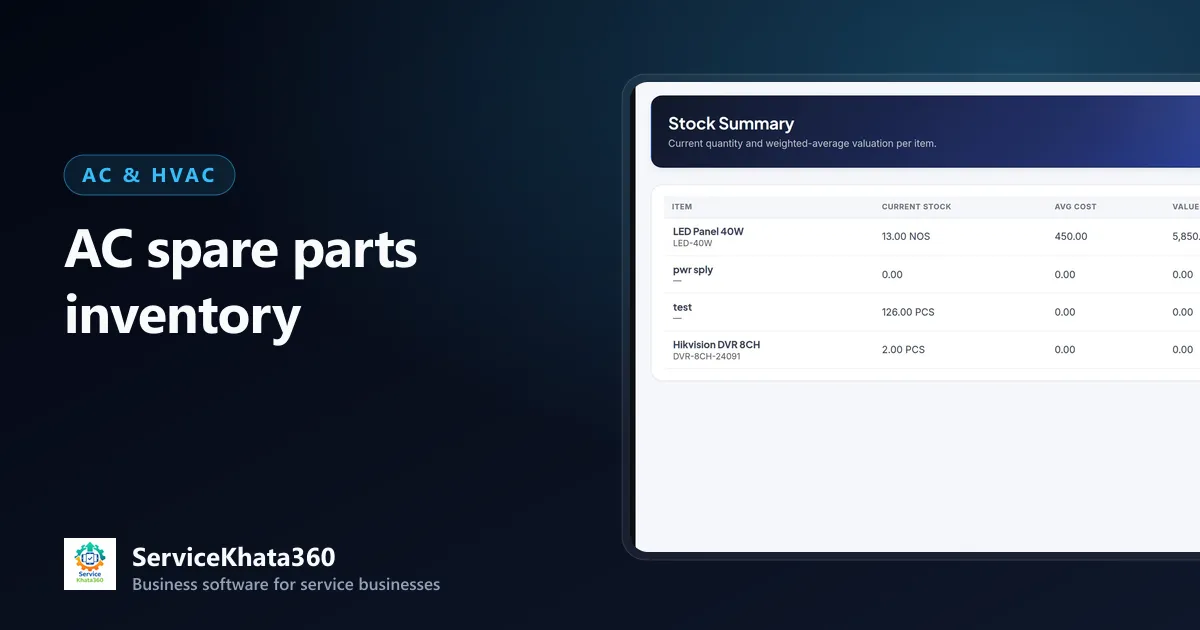
When a technician reaches a site and the capacitor or PCB is not in stock, a 40-minute job becomes a second visit, an unhappy customer and a lost day. When parts leave the store and never reach the invoice, the business loses money without noticing. Both problems come from the same gap: stock that is not tracked closely enough.
This guide covers how AC service businesses can manage spare parts and service inventory practically.
What an AC business usually stocks
- Fast-moving spares — capacitors, contactors, fan motors, sensors, remote controls
- Higher-value parts — PCBs, compressors, outdoor fan blades
- Installation material — copper pipe, insulation, drain pipe, stands and brackets, cable
- Consumables — refrigerant gas, brazing material, tape, cleaning chemicals
- Complete units — split and window ACs for sale and installation
1. Build a clean item list
Name items consistently so the same part does not exist twice. For each item, set the unit (piece, metre, kg, cylinder), HSN code, GST rate, purchase and sale price and a low-stock level. For PCBs and other model-specific parts, include the compatible models in the item name or description.
2. Stock moves only through documents
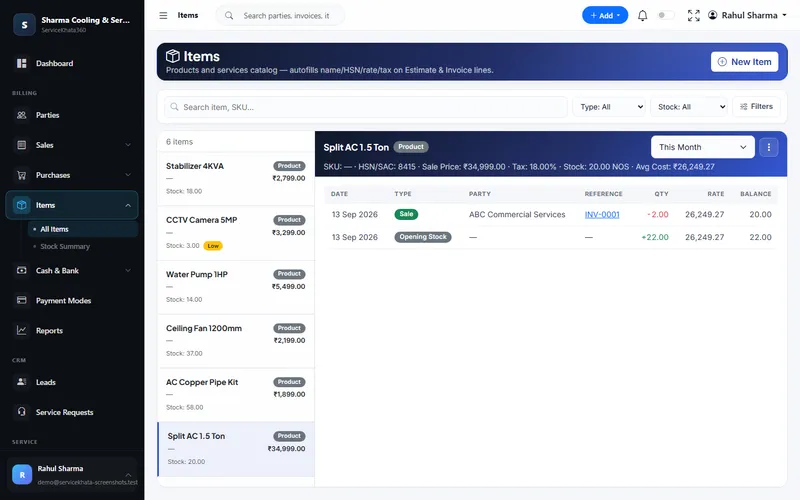
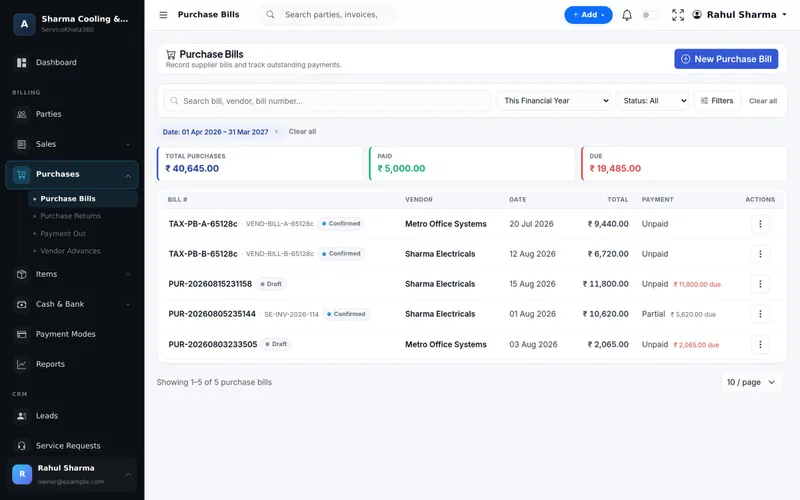
- Supplier bill → stock in
- Customer invoice → stock out
- Material issued to an installation project → out to site; returns → back in
- Purchase return → back to supplier
When stock only changes through a document, the question "where did the 10 capacitors go?" always has an answer.
3. Make sure every part used gets billed
The most common leak in AC service is parts used on a job that never reach the invoice. A simple rule fixes most of it: a complaint is not closed until the parts used are on an invoice — or noted as covered under warranty or AMC.
4. Set reorder levels before summer
For each fast-moving part, look at how many you used in last year's busiest month and how many days your supplier takes to deliver. Set the low-stock level high enough to cover that delivery time in peak season. Review the levels again in February.
5. Track refrigerant in one unit
Gas is often bought by cylinder and charged by kilogram or by job. Choose one unit and use it everywhere — purchase, stock and billing — or your stock will never reconcile.
6. Know your stock value
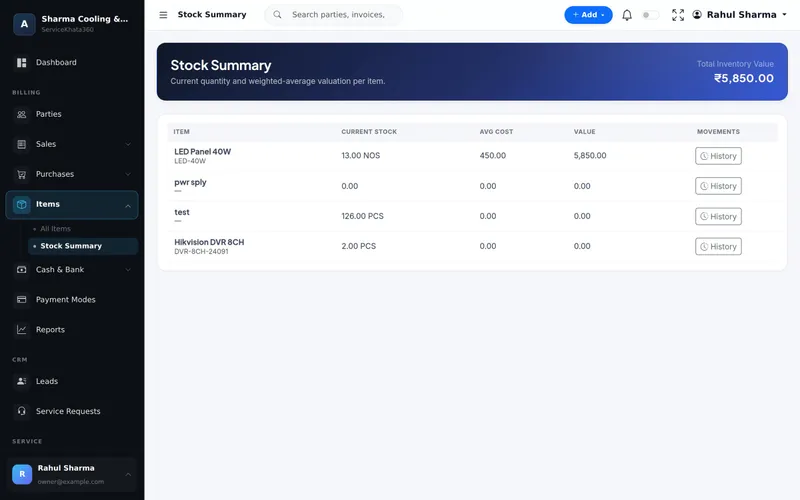
Average cost tells you what your stock is really worth and what each job really cost. It also shows slow-moving items — old PCBs for discontinued models — that are tying up money.
7. Technicians' van stock
Many businesses give technicians a small kit of common parts. Treat it as stock that still belongs to the store: issue it, and record what was used against jobs. Even a weekly check of van stock against jobs completed catches most losses.
8. Count a little, often
Rather than one painful annual stock-take, count one category each week — capacitors this week, PCBs next week. Differences are small and easy to trace while they are recent.
Connect parts to jobs waiting for parts
Every job marked "waiting for parts" is a purchase decision. Review them daily with the store so the order goes out the same day. See assigning AC service calls to technicians for how to keep those jobs visible.
How ServiceKhata360 manages AC inventory
ServiceKhata360 keeps live stock and weighted-average cost for every item, flags items below their low-stock level, and links every stock change to its purchase bill, invoice or return. Purchase bills update stock and vendor balances; invoices reduce stock as parts are billed; installation projects record material issued and returned. Serial numbers can be recorded per unit for ACs and other warranty items.
Read more about inventory management and purchase and vendor management, or see the complete ServiceKhata360 AC service solution.
Frequently Asked Questions
How do I set a reorder level for AC spares?
How should refrigerant gas be tracked?
Does ServiceKhata360 value stock at average cost?
Looking for one system to manage your AC service business?
See ServiceKhata360 with your own workflow — enquiries, estimates, technicians, service calls, billing and AMC.