How to Manage Solar Leads and Follow-Ups
Solar customers take weeks or months to decide. How to qualify rooftop solar enquiries, keep long follow-up cycles organised and make sure no interested customer goes cold.
A rooftop solar decision is a big purchase for most families and small businesses. They compare quotations, talk to neighbours who installed last year, wait for a bonus, ask about subsidies, and often say "call me after Diwali". A solar business that follows up well wins jobs its competitors forgot about.
This guide covers how to capture, qualify and follow up solar leads so that long sales cycles do not turn into lost customers.
Where solar leads come from
- Referrals from existing customers — often the best quality
- Calls and WhatsApp from local advertising
- Website and social media enquiries
- Electricians, builders and architects
- Housing societies and commercial buildings
Record the source for every lead. After a few months you will know which sources produce customers, not just enquiries.
Step 1: Log every enquiry the same day
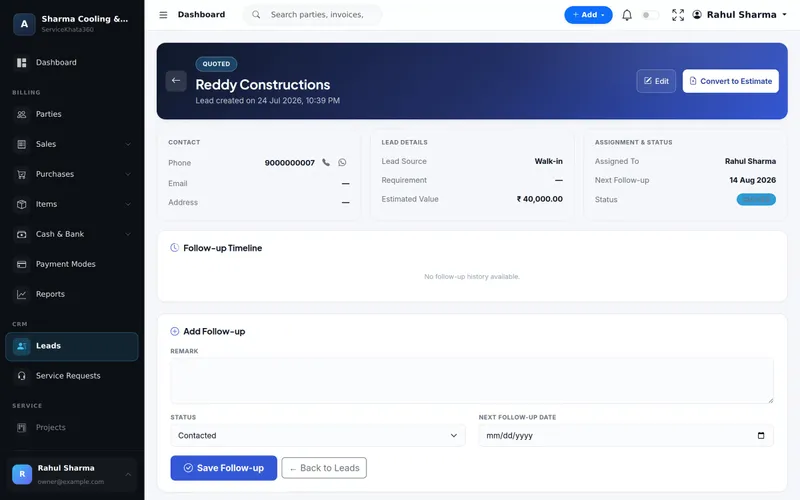
Each lead needs name, phone, location, source, requirement, assigned salesperson and next follow-up date. The requirement can start rough — "rooftop for 2-storey house, bill around ₹4,000/month" — and be refined later.
Step 2: Qualify before you survey
A site survey costs a salesperson half a day. A short qualifying call decides whether it is worth it now:
- Property type and roof — RCC, tin shed, available area
- Monthly electricity units from recent bills
- Sanctioned load and connection type
- On-grid, off-grid or hybrid; battery backup needed?
- Interest in a subsidy scheme, if applicable
- Budget and decision timeline
- Who decides — owner, family, partners, society committee
Step 3: Use stages that match reality
Keep stages simple so the team updates them: New → Contacted → Quoted → Converted, or Lost with a reason. A lead that is "Quoted" without a next follow-up date is a lead you are losing.
Step 4: Follow up with a reason and a date
The most useful habit in solar sales is recording why the customer is waiting, and setting the next date to match:
- "Waiting for son's opinion, he visits on 15th" → follow up on the 16th
- "Wants to decide after Diwali" → follow up the week after Diwali
- "Comparing with another quote" → call in two days with a comparison of components
- "Roof repair first" → follow up in a month
This replaces aimless weekly "any update?" calls with conversations the customer expects.
Step 5: Give useful information at each follow-up
- Explain the difference between panel types or inverter brands in their quotation
- Share photos of a similar installation you did (with that customer's permission)
- Explain the installation timeline and what happens on each day
- Clarify warranty and after-sales service
Step 6: Record lost reasons — and revisit them
"Price too high", "chose another installer", "postponed to next year". Postponed leads are future customers: give them a follow-up date months ahead. Price-lost leads tell you whether your offer needs a lower-cost option.
Daily and weekly routine
- Daily: every salesperson clears their follow-ups due today — update or reschedule each one.
- Weekly: review quoted leads older than two weeks, leads without a next date, and conversions by source.
From lead to survey and quotation
Once qualified, schedule the survey and then the quotation. See how to manage solar site surveys and quotations.
Doing it in ServiceKhata360
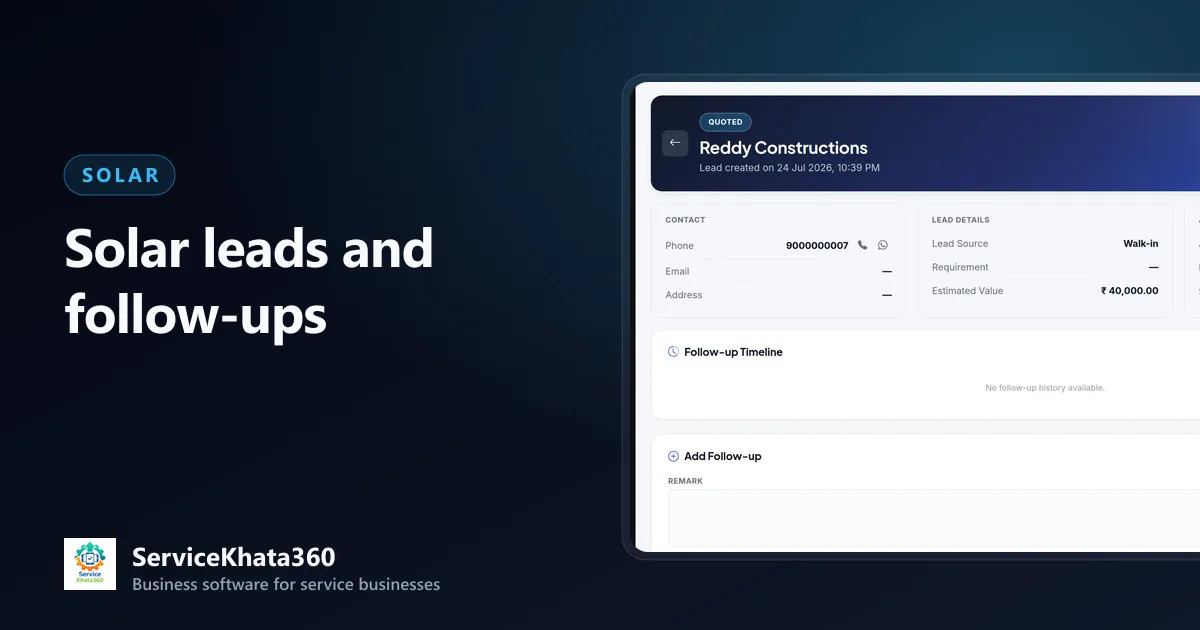
ServiceKhata360 leads carry source, status, assigned salesperson, estimated value and next follow-up date. Each follow-up is logged with a remark and the next date, and leads due appear in follow-ups on the dashboard, so any salesperson can continue the conversation with full context. Leads can be viewed as a list or a Kanban board, and Convert to Estimate moves a qualified lead into a GST quotation. Sales Visits records survey visits with check-in, purpose and outcome.
Explore lead management, or see how leads connect to projects and billing in ServiceKhata360 for solar businesses.
Frequently Asked Questions
What questions should I ask a new solar enquiry?
How long should I keep following up a solar lead?
Can different salespeople pick up the same lead?
Looking for one system to manage your solar business?
See ServiceKhata360 with your own workflow — leads, site surveys, quotations, projects, material, billing and AMC.